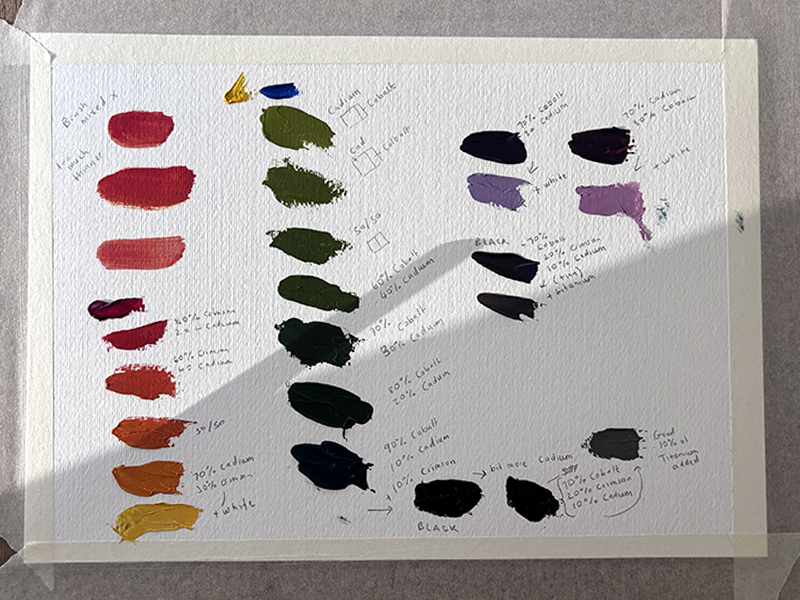
I have always known, in the way you know a fact without really knowing it, that you can make almost anything from red, yellow and blue. It is one of those things you are told quite early on in school art class but didn’t really understand it or never really practiced the art of mixing primaries. So today I did. I taped a sheet of oil paper to the table, squeezed out a cadmium yellow, a cadmium red, and a cobalt blue, and gave myself an afternoon to see what they were really capable of.
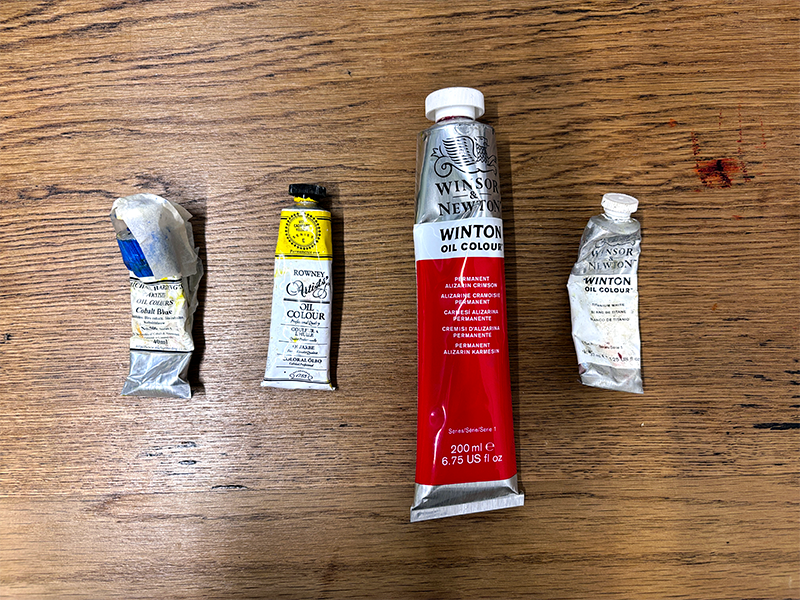
The three tubes, well 4 including the Titanium White. The Michael Harding Cobalt Blue, Rowney Cadmium Yellow series E and Winsor and Newton Titanium White series 1 are rather old, bought when I first started learning about oil painting. The larger Winsor and Newton Alizarin Crimson is a recent buy to complete the three primary…
The exercise
The first column was straightforward enough. Crimson into cadmium, in different measures, walking from a deep pink through to orange and on to a colour that was practically a warm gold by the time white joined in. I could see the whole thing coming and mostly it behaved. But the moment I moved on to greens I understood why so many painted landscapes end up looking a bit municipal. Cadmium and cobalt on their own gave me something closer to khaki than any leaf I have ever stood under, and it took several goes, nudging the ratio one way and then the other, before I found a green with any life in it. Sixty percent cobalt to forty cadmium, roughly, was where it started to sing. Any more yellow and it went sickly. Any more blue and it went flat.
The surprise of black
The real surprise was the last column. I had always reached for a tube of black without giving it much thought, the way you reach for salt without measuring it. But mixing my own, from cobalt, crimson and a touch of cadmium, gave me something with far more depth than anything from a tube. There was a purple lurking in there, and a bottle green, and once I added white it came out lilac rather than grey. A black that is actually made of colour behaves quite differently from a black that is simply black, and it was only by mixing it myself, badly at first, that I understood why.
Why this matters
I know this is exactly the kind of exercise every painting book tells you to do in the first chapter, and I have skimmed past that chapter more than once over the years, always keen to get on with something that looked more like a painting. What I am learning, rather later than I would like, is that this is the painting. Or at least it is the part that everything else depends on. You cannot really see what you are doing with colour until you have stood in front of a palette and made the mistakes for yourself, watched a green go muddy and had to work out why, rather than simply reading that it might.
I mentioned in my first post here that colour is relational, that a yellow changes depending on what sits beside it. Today’s exercise has given me the raw material to actually test that properly, now that I have a small library of mixes with notes on how I got there, rather than just a feeling I am chasing from memory each time.
While I had paint on my hands I had the Louisiana Channel’s interview with David Hockney playing in the background, one of the last videos he did before passing away a few weeks ago. He makes the point that everything drawn or painted is an abstraction, however faithful it looks, because you are always translating a three-dimensional, moving, coloured world onto a flat surface using marks that are never quite the thing itself. I found that oddly reassuring while looking at nine little smears of paint that were meant to be a leaf. My green is not going to be the hedge outside my window. It was never going to be. It is my abstraction of it, built from three tubes of paint and an afternoon of getting it wrong, and that is rather the point of doing it by hand at all. He also talks in that same series about painting needing the hand, the eye and the heart together, and today felt like a fairly literal demonstration of that: the hand mixing, the eye judging, and a fair bit of heart required to keep going once the fourth green in a row still was not right. If you have half an hour, it is well worth watching in full: David Hockney interviewed by Louisiana Channel.
Practical advice for beginners
If you are starting out and colour feels like a mystery, as it did to me for a long time, my only real advice from today is this: buy three tubes, tape down a sheet of paper, and just mix. Write down your ratios as you go, because you will not remember them otherwise, and expect the first few to disappoint you. That disappointment is doing something useful. It is teaching you far more than a colour wheel ever could, and it is exactly where I said in my first post about learning to see colour that most of my real education has come from.
Thank you for reading this one. I have a feeling I will be back at that palette again before the week is out.